A retail brand buys a wood display stand as a selling asset. It must present the right assortment, fit a real store, survive daily use, and remain economical across production, freight, installation, and replenishment. The decision therefore begins with commercial performance, not a preferred shape or finish.
This buying guide uses a stage-gate approach for comparing concepts and manufacturers. Each gate removes a different commercial, engineering, delivery, or repeat-order risk.
Set the Commercial Test Before Reviewing Designs
A display brief should state what success means. More facings, a product launch, cross-selling, premium positioning, or better navigation require different fixture decisions. Without a measurable purpose, buyers may approve an attractive rendering rather than a useful retail tool.
Choose one primary retail outcome
Define the main job in operational language: hold a complete colour range within a fixed footprint, place trial products at hand height, or create a branded destination visible from the aisle. Secondary benefits should not compete with the principal objective.
Write the pass condition
Translate the objective into evidence that can be checked during a pilot. Useful measures include stock capacity, shopper access, replenishment time, percentage of facings visible, installation time, and sales per occupied area. A display cannot be improved consistently if success remains subjective.
Start With Merchandise Architecture
The product range determines the fixture more than the fixture determines the range. Buyers should map every SKU, package orientation, weight, selling priority, and expected stock depth before discussing the outer appearance.
Separate hero, core, and supporting products
Hero products deserve immediate visibility, while core lines need dependable capacity and supporting items may work as cross-sell attachments. Treating every SKU equally often creates a crowded display with weak visual hierarchy.
Allow for range change
Retail assortments rarely remain fixed. Adjustable shelves, removable dividers, interchangeable trays, or replaceable graphic zones can extend useful life. Flexibility should be deliberate, however; excessive adjustment adds hardware, tolerance risk, and store complexity.

Match the Format to the Selling Zone
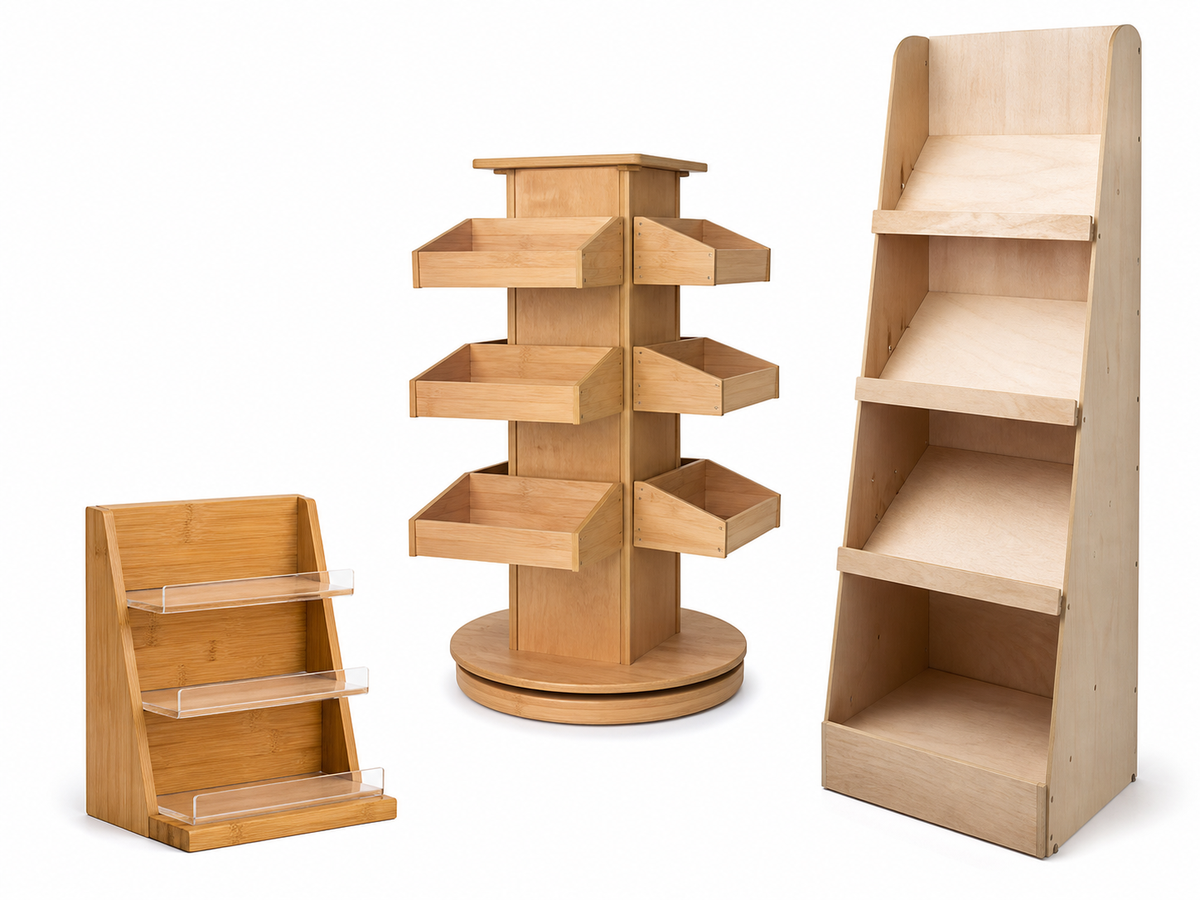
Floor stands, countertop units, rotating displays, double-sided fixtures, slatwall systems, and shelving solve different space and traffic problems. TP Display publishes wooden examples across these formats, including bamboo countertop, oak tiered, rotating, and double-sided units.
Protect circulation and sightlines
A floor unit must preserve aisle clearance, emergency access, adjacent category visibility, and a comfortable customer approach. Countertop units need a controlled footprint that does not interfere with payment, sampling, or staff work. Rotating units require safe reach and enough clearance for loaded movement.
Design for the number of shopping faces
A single-sided display suits a wall or controlled approach. Double-sided and rotating structures can create more selling area in open locations, but they also change stability, stocking, graphic placement, and inspection requirements.
Buy the Material System, Not the Word Wood
Wood is not a complete purchasing specification. The published TP Display range visibly includes plywood, oak, bamboo, and wood combined with metal or acrylic. Each choice changes appearance, structural behaviour, edge treatment, weight, cleaning, and freight exposure.
Ask for an exact construction description
The quotation and drawing should identify the substrate, thickness, finish, reinforcement, joint method, exposed edges, hardware, and allowable substitutions. Physical finish samples are more reliable than a colour value viewed on different screens.
Use hybrid materials with a purpose
Metal may strengthen long spans or mobile bases, while acrylic can create transparent trays and sign holders. Mixed materials are valuable when each one solves a defined retail or engineering problem; decorative complexity without a function usually increases coordination and replacement risk.
Compare Suppliers With Evidence
Quotations become meaningful only when suppliers are responding to the same scope. Price should be reviewed beside engineering evidence, prototype discipline, quality controls, packing logic, and repeat-order management.
Use a weighted buying matrix
Weighting should reflect the programme. A concept test may emphasise adaptability; a national rollout should favour repeatability, packaging, documentation, and capacity. The matrix is a starting point, not a universal formula.
| Criterion | Suggested weight | Evidence to request | Risk if weak |
| Retail fit | 25% | Loaded concept and store dimensions | Poor access or wasted space |
| Engineering | 25% | Drawing, load assumptions, prototype | Instability or early failure |
| Quality control | 20% | Acceptance limits and inspection plan | Inconsistent production |
| Delivery readiness | 15% | Packing test and assembly method | Damage or slow installation |
| Reorder control | 15% | Codes, samples, substitution rules | Batch-to-batch drift |
Score each supplier against submitted evidence, not sales promises. A lower score should trigger a clarification, sample test, or commercial allowance instead of being hidden inside an overall impression.
Model Total Landed Cost
Unit price is only one part of the investment. A design that appears economical at the factory can become expensive when it consumes excessive carton volume, requires specialist installation, arrives damaged, or cannot be repaired in the field.
Include the costs after production
A practical model covers sampling, tooling, inspection, packaging, freight volume, duties, handling, store assembly, spare parts, disposal, and replacement. These elements expose trade-offs hidden by an ex-works price.
● Measure packed dimensions and weight, not only assembled size.
● Record assembly time, tools, hardware count, and required skill.
● Estimate damage exposure and the cost of replacement components.
● Separate one-time development costs from repeat production costs.
Make the Prototype Answer Retail Questions
A prototype is not merely a colour sample. It is the first opportunity to test whether the concept behaves correctly with real merchandise and real users.
Run a loaded store simulation
Load the complete assortment, apply final graphics, and observe reach, product removal, restocking, visibility, wobble, deflection, moving parts, and cleaning access. Ask store staff to assemble or service the unit without designer coaching.
Record decisions as controlled changes
Every revision should update the drawing, bill of materials, finish reference, graphics, packing plan, and acceptance criteria. Comments scattered through email are not a production specification.
Approve Quality Around Failure Risk
Quality control should focus on what would damage selling performance or brand trust. Generic instructions such as good finish or strong structure do not tell inspectors what to accept.
Define visible and functional limits
Agree tolerances for dimensions, colour variation, edge quality, graphic position, stability, loaded deflection, hardware operation, and carton condition. Inspection severity should reflect where a defect appears and how it affects use.
Keep a reference set
Retain approved material samples, colour chips, graphics, hardware, drawings, and a signed prototype or golden sample. These references reduce interpretation when production repeats months later.
Pilot the Display Before Scaling
A controlled pilot reveals whether laboratory approval survives store reality. Select locations that represent different traffic levels, staff routines, store sizes, and customer behaviour rather than testing only in the easiest flagship environment.
Collect operational evidence
Photograph the display at installation and agreed intervals. Record replenishment, damage, interaction, stock-outs, graphic wear, cleaning issues, and available sales data. Separate fixture problems from assortment, location, or execution problems.
● Confirm the unit arrives with the correct parts and instructions.
● Check whether one employee can replenish it safely and quickly.

Plan the Rollout and Reorder System
Scaling requires tighter control than sampling. Agree store lists, delivery waves, carton identification, spare parts, installation responsibility, and issue escalation before mass shipment.
Freeze what must remain consistent
Protect the approved geometry, substrate, finish, colours, hardware, graphics, packaging, and test criteria. If a component becomes unavailable, require written approval of the substitute and confirmation of any effect on appearance, strength, assembly, or price.
Choose a manufacturer that can coordinate the build
TP Display shows wooden, metal, and acrylic workshops together with material storage, packing, and stock areas. That published capability is relevant to mixed-material fixtures, but buyers should still validate the proposed process through drawings, samples, inspection terms, capacity confirmation, and order-specific documentation.
Conclusion
The best wood display stand is not the one with the richest finish or the lowest quoted price. It is the option that passes a sequence of commercial, merchandising, engineering, cost, quality, and rollout tests.
A stronger purchase defines the selling outcome, maps merchandise, specifies the material system, compares suppliers with evidence, models landed cost, and learns from a pilot before scaling.
FAQ
What should a retail brand prepare before requesting a quote?
Prepare the retail objective, SKU data, store dimensions, quantity, delivery markets, graphics, target timing, and packing expectations.
Which wood display format works in an open aisle?
Double-sided or rotating displays can use open space efficiently, provided circulation, stability, reach, and replenishment are tested.
How should suppliers be compared?
Compare common-scope pricing with engineering evidence, prototype quality, inspection controls, packing, capacity, and reorder documentation.
Why is landed cost more useful than unit price?
It includes packing, freight, installation, damage, handling, replacement, and other costs that affect the real programme budget.
When is a store pilot necessary?
A pilot is valuable before a multi-store rollout because it tests shopper use, staff handling, durability, replenishment, and location fit.
What controls repeat-order consistency?
Approved drawings, physical samples, material codes, hardware, graphics, packaging, test criteria, and written substitution rules.
Post time: Aug-26-2026