A wooden retail display has to perform in three environments at once. It must attract shoppers on the selling floor, support staff during replenishment, and survive the distribution route that carries it from factory to store. Treating it as decorated furniture overlooks the engineering choices that determine whether products remain visible, shelves stay level, graphics align, and repeat orders match the approved sample.
TP Display manufactures custom retail fixtures in wood as well as hybrid combinations of wood, metal, acrylic, lighting, and printed components. Its published workshop processes include wood panel cutting, surface preparation, grinding, edge banding, packing, and material storage. This manufacturing range makes it possible to select a display system around the merchandise and retail task instead of forcing every project into one construction method.
Start With the Retail Task
Before choosing a board or finish, define what the fixture must change in the store. A launch display may prioritize immediate brand recognition and rapid installation. A permanent category unit needs adjustable capacity, durable edges, and components that can be serviced. A shop-in-shop fixture may need storage, power, and coordinated finishes across several modules.
Format and placement decision
The brief should identify the store position, viewing direction, campaign life, expected quantity, replenishment frequency, and measurable product capacity. These details establish the display format more reliably than a mood board alone.
Map shopper approach and visibility
Record whether shoppers see the fixture from the front, both sides, or from several aisle directions. Header height, side-panel depth, product angle, and graphic placement should respond to that approach.
Choose a Structural Family
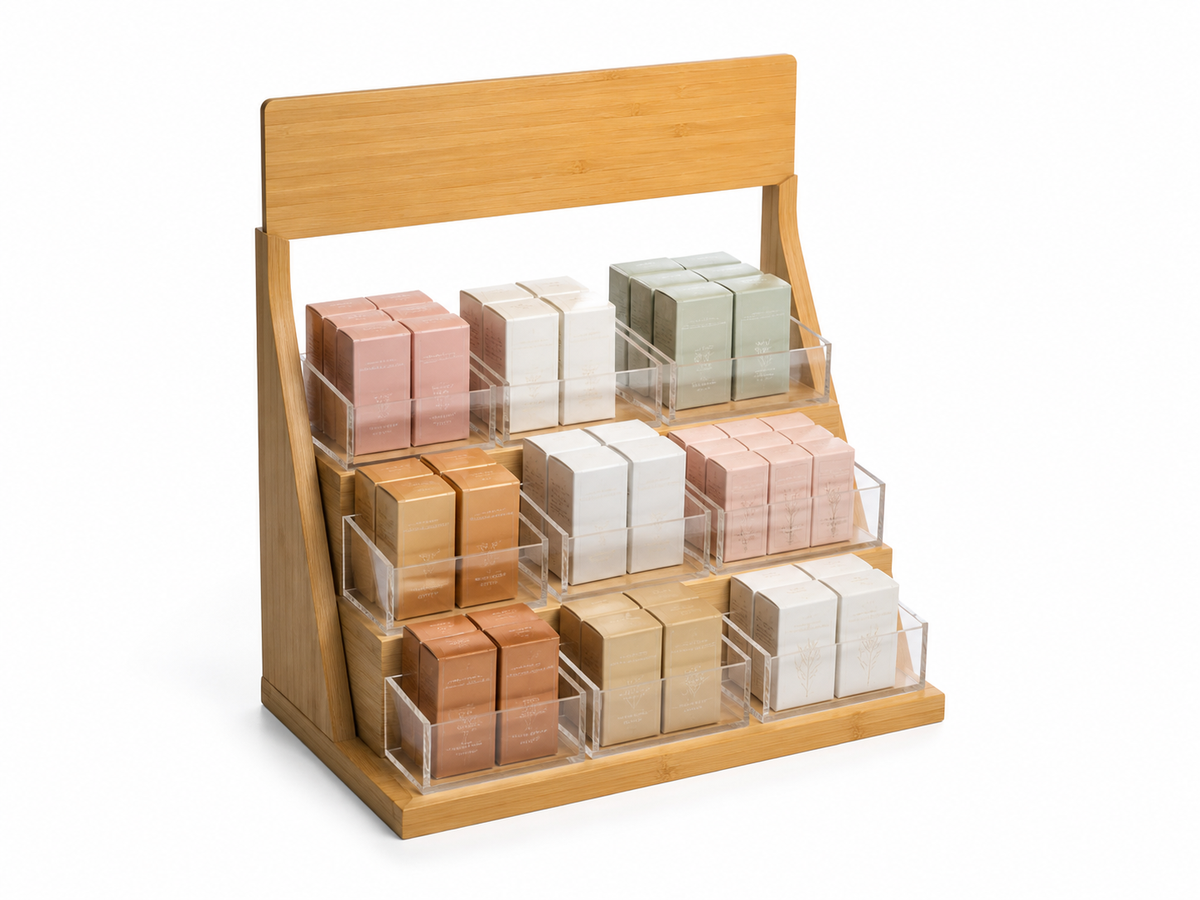
Wooden retail displays can be organized by how they occupy space and present merchandise. The correct family determines access, capacity, stability, and freight volume. A unit placed against a wall should not be engineered like an island, and a rotating tower should not be evaluated like a fixed shelf.
Floor-standing and gondola displays
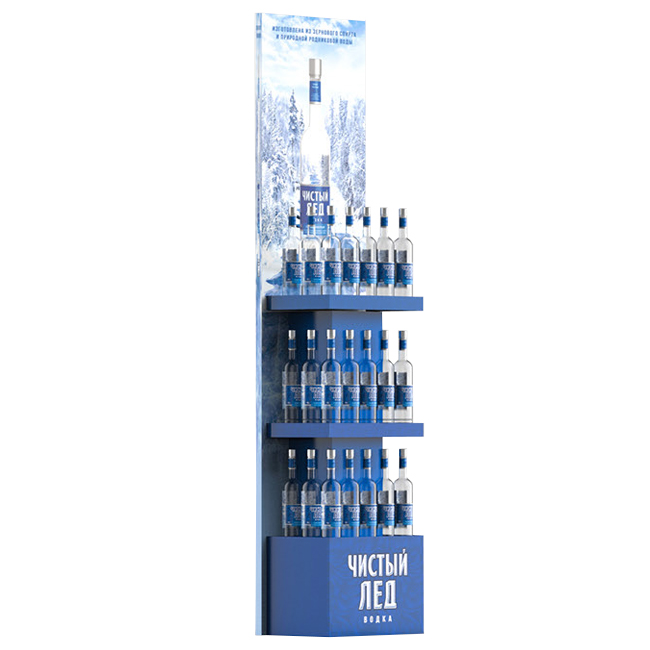
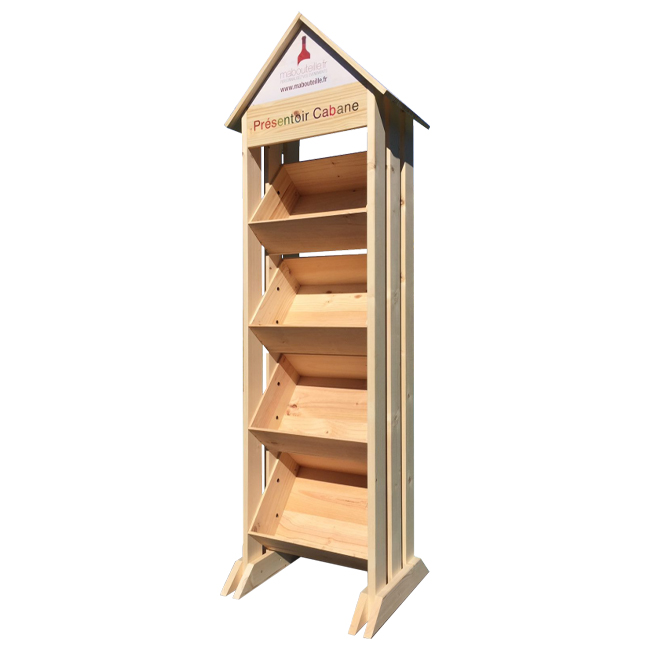
Single-sided floor stands work beside walls or at aisle edges. Double-sided gondolas create independent selling zones in open plans. Both require a stable base, controlled shelf deflection, and clear product facings.
Countertop and tiered displays
Compact units place small products close to a decision point. Their height must preserve visibility across the counter, while their base must resist tipping when products are removed unevenly.
Select Materials by Function
The visible word “wood” can describe very different constructions. MDF, plywood, laminated particleboard, solid timber, bamboo panels, and veneered boards vary in weight, screw holding, edge behavior, surface quality, and cost. Material selection should follow the structural and finish requirements rather than perceived prestige.
| Material option | Best suited to | Critical approval point |
| MDF | Painted panels, routed details, smooth branded surfaces | Edge sealing, weight, and fastening zones |
| Plywood | Load-bearing panels and knock-down structures | Core quality, face grade, and exposed edges |
| Laminated board | Repeatable woodgrain and easy-clean shelving | Edge banding and moisture protection |
| Solid wood or veneer | Premium tactile and natural presentation | Color and grain variation expectations |
| Wood-metal hybrid | Long spans, mobility, and concentrated loads | Joint tolerances and finish compatibility |
Engineer Around Real Merchandise
Capacity should be calculated with actual product dimensions and weights. Shelf length multiplied by nominal pack width is not enough because dividers, lips, label holders, finger clearance, and product variation consume space. Heavy books, bottles, appliances, and bulk packs also create different load patterns from lightweight cosmetics or accessories.
Set usable dimensions and load limits
State clear shelf width, depth, opening height, product facings, maximum load, and adjustment increments. Test the complete shelf assembly rather than the board in isolation.
Check stability during partial sell-through
A fixture may be balanced when fully stocked but less stable when products remain on only one side or on the upper shelves. The test plan should reproduce uneven loading and shopper contact.
● Confirm the smallest and largest pack in the assortment
● Test shelf lips, hooks, trays, dividers, and product stops
● Check reach at upper and lower selling zones
● Allow space for price labels and required product information
● Verify that replenishment does not block the aisle
Turn Surface Finish Into a Controlled Standard
Finish affects brand perception, cleaning, abrasion resistance, and repeat-order consistency. Painted MDF offers precise color; laminate offers repeatable texture and practical maintenance; veneer provides natural character; and clear-coated plywood can make construction part of the visual language.
Hybrid construction logic
Approval should use a production-representative panel large enough to show color, gloss, texture, grain direction, edge treatment, and interaction with graphics. Store lighting can alter both wood tone and printed color, so samples should be reviewed under relevant illumination.
Match Construction to the Product Category
Applications differ because shopper behavior and product handling differ. A fixture should be designed around those differences rather than receiving category graphics after engineering is complete.
Beauty, electronics, and technical products
Beauty displays may require testers, mirrors, lighting, and easy-clean trays. Electronics may add cable routing, security, screens, power supplies, ventilation, and precisely located holders.
Food, beverage, books, and giftware
Food and beverage fixtures prioritize load, shelf lips, replenishment, and spill resistance. Books require strong shelves and face-out presentation. Giftware benefits from variable elevations and secure organization for small or fragile items.
Design the Shipping Form Early
Freight and store labor are part of display performance. Fully assembled units reduce setup but occupy more cubic volume. Knock-down construction can improve container utilization, yet connectors, hardware control, instructions, and assembly accuracy become critical. Semi-assembled designs can protect complex sections while limiting carton size.
Run a packaging trial
Pack a production-intent sample with corner protection, surface separators, hardware bags, instructions, and carton markings. Review carton weight, drop exposure, pallet pattern, and abrasion risk.
Approve the Display in Stages
A reliable approval sequence closes risks in the order they appear. The drawing confirms geometry; finish samples confirm appearance; the prototype confirms use; a pre-production unit confirms the intended process; and inspection confirms batch consistency. Skipping a stage transfers unresolved decisions into production.
Prototype with production intent
Use the planned board thicknesses, connectors, hardware, surface system, graphics, and accessories wherever practical. Load and merchandise it in the expected configuration.
Freeze one controlled specification
Consolidate signed drawings, materials, physical finish references, artwork, tests, packaging, labels, and approved deviations. Email comments should not remain the only production record.
Build Quality Checks Around Failure Modes
Generic statements such as “good quality” do not tell inspectors what to accept. Criteria should target the ways the display could fail commercially: instability, excessive shelf deflection, poor alignment, edge damage, incorrect color, weak graphics, difficult assembly, non-working accessories, or inadequate packing.
Separate functional and cosmetic acceptance
Functional checks cover load, stability, doors, locks, casters, rotation, lighting, and connectors. Cosmetic checks define viewing distance, scratches, gaps, glue residue, color variation, and print defects.
Plan for Refresh and Repeat Orders
Retail programs often outlive the first graphic campaign. Replaceable headers, magnetic or slotted graphics, standardized shelves, accessible lighting, and coded hardware can extend the fixture’s useful life. Repeat orders also need controlled material and component references so substitutions do not gradually change appearance or performance.
Conclusion
A wooden retail display is successful when format, materials, load performance, finish, application details, packing, and approval controls work as one system. The choice between MDF, plywood, laminate, timber, or a hybrid structure only becomes meaningful after the retail task and operating conditions are clear.
Format and placement decision
TP Display’s wooden product range and multi-material workshop are relevant to brands that need custom floor stands, countertop fixtures, rotating units, branded shelving, or mixed-material displays. A complete brief gives its engineering and production teams the basis to develop a display that can be approved, shipped, installed, and repeated with confidence.
FAQ
Which material is best for a wooden retail display?
The best material depends on load, surface finish, fastening, shipping weight, service life, and budget. MDF, plywood, laminated board, and solid wood solve different requirements.
Can wooden retail displays be shipped flat-packed?
Yes. Knock-down construction can reduce freight volume, but connectors, assembly time, instructions, and final stability must be tested before production.
How should shelf load be specified?
State the usable shelf dimensions, distributed and concentrated load assumptions, support points, and acceptable deflection. Test the complete shelf assembly with production hardware.
What information should a buyer provide for a quotation?
Provide product dimensions and weights, capacity, store position, size limits, finish direction, brand artwork, quantity, delivery market, timing, and accessory requirements.
Is a prototype necessary for a custom display?
A prototype is strongly recommended for a new structure, finish, moving part, electrical feature, knock-down system, or multi-store rollout.
How can a brand keep repeat orders consistent?
Maintain approved drawings, physical finish masters, material and hardware codes, inspection criteria, and formal rules for substitutions.
Post time: Aug-26-2026